
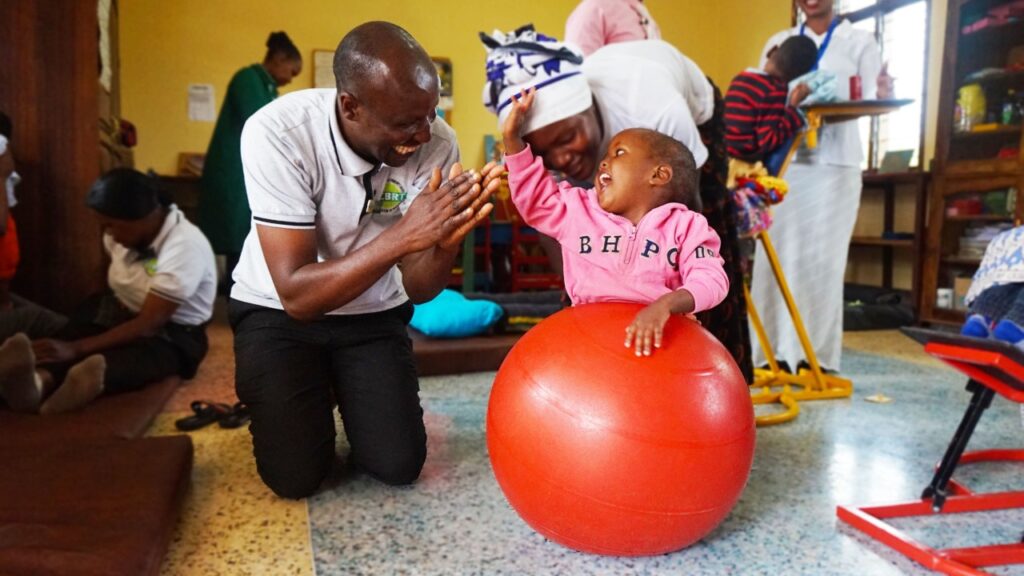
During this week’s community engagement meeting with local actors in the Spina Bifida and Hydrocephalus ecosystem in Mukono district, a sub county based health worker mentioned something that got us reflecting even more deeply about how much of the resources we have, in out community that we under-utilize when it comes to supporting children with disabilities. The first, and often the only thing many people think about is is buried in a myth, that clinical care is the ‘silver bullet’ towards addressing all the disability support needs an individual may have. She said:
“Community-based rehabilitation for children with spina bifida and hydrocephalus in Uganda is not a substitute for clinical care. It is the reason clinical care survives”.
Let me show you why you should believe her. And perhaps give you a new thinking hat about spina bifida and hydrocephalus care in Uganda.
Research from CURE Children’s Hospital Uganda (Warf, et al, 2011) one of the most rigorous studies of its kind conducted on this continent found that the single most important determinant of five-year survival for children with hydrocephalus was not the type of surgery they received. It was whether they had access to a community-based rehabilitation program. Children with that access had mortality rates close to their unaffected peers, at approximately 16%. Children without it faced mortality rates above 50%. More than triple!
Considering the above statistics, the community was not a complement to care. The community was the difference between life and death.
And yet Uganda’s response to spina bifida and hydrocephalus (SBH) remains overwhelmingly centralized. Anchored in a handful of specialist hospitals in Kampala, Mbale, and Mbarara, reachable by a fraction of the families who need them, and dependent on funding and supply chains that are increasingly fragile. For most families, in the regions of Karamoja and Acholi, as well as in the rural stretches of Busoga and Kigezi, the journey to a neurosurgeon is not just expensive. For many, it is impossible.
We are treating a nationwide crisis with city-center solutions. And children are dying for it.
What we already have and are not using
Here is what makes this particularly urgent and particularly solvable; Uganda does not lack community knowledge. It lacks a structured pathway to put that knowledge to work.
Across the country, Village Health Teams (VHTs) sit in nearly every sub-county. Traditional Birth Attendants (TBAs), often the first contact for families of newborns with SBH carry a degree community trust that no referral form can replicate. Faith-based leaders, who in northern Uganda have already helped dismantle the belief that these children are cursed or demonic, hold moral authority that clinical professionals simply do not have at the village level. Parent networks, informal, self-organized, sustained by shared suffering and shared hope already exist in many districts, meeting under trees, in church halls, and over e-platforms.
None of this is exotic. None of it requires import. It is already here. What is missing is the formal recognition, the structured training, and the deliberate linkage of these community assets into Uganda’s clinical care pathways for SBH.
Community-based rehabilitation is not a low-cost substitute for real care. It is what makes real care reachable, sustainable, and survivable for families who cannot afford the alternative.
A trained community health worker who can recognize early signs of shunt failure and trigger an emergency referral is not replacing a neurosurgeon. They are the early warning system that gets a child to that neurosurgeon alive. A life-line for survival. A parent group teaching catheterization and continence management in a local language is not replacing a urologist. They are extending the urologist’s reach by hundreds of kilometers at near-zero cost, with near-perfect contextual accuracy. Restoring dignity where it would have otherwise been lost.
The lesson from Tanzania: Parents who changed national policy
In Dar-es-Salaam, when the CCBRT hospital discontinued surgery for children with spina bifida and hydrocephalus possibly due to funding gaps, loss of specialized neurosurgical staff, or a strategic shift in CCBRT’s mandate, families faced a catastrophic gap. There was no fallback. No government alternative. No plan. What happened next was not a donor intervention or an international NGO program. It was parents.
The Association for Spina Bifida and Hydrocephalus Tanzania (ASBAHT) formed in 2001, registered as an NGO in 2002, went directly to the press and to politicians. They named the crisis publicly. They lobbied relentlessly. And they won. The Muhimbili Orthopaedic Institute, a national government hospital, took over surgical responsibility. The national hospital assumed what no external actor had managed to force; full state accountability for these children’s lives.
ASBAHT did not stop at that, in fact the parent group raised funds for medical equipment. It built awareness. It trained families in continence management. It became the connective tissue between communities and the formal health system, the exact role that Community Based Rehabilitation is designed to play. Awaken local agency and give rise to community driven self-help and development processes. Without the active organizing of that parent group, none of it would have happened. A community organized itself, and a government moved.
Uganda has the ingredients for exactly this kind of movement.
What a Uganda model must include
- Train Village Health Teams in SBH recognition and emergency referral. VHTs are already mandated, trusted, and present. A structured SBH training module, identifying warning signs of shunt failure and raised intracranial pressure would create an early-warning network at sub-county level that no hospital can replicate from the center.
- Formalize and resource parent support groups as frontline CBR agents. Tanzania’s ASBAHT proved that organized parents are the most effective advocates, the most credible educators, and the most resilient long-term supporters of children with SBH. Uganda’s informal parent networks need institutional recognition, basic capacity building, and linkage to district health systems and not simply management from above, but cultivating genuine partnerships that are both mutual and accountable.
- Embed continence management and physiotherapy training in community health curricula. The majority of SBH related complications that reduce quality of life such as urinary tract infections, pressure sores and contractures are manageable at home with the correct technique simply deployed. Teaching caregivers and community health workers these skills, in local languages, with locally available materials, is not a downgrade of care. It is care, delivered where children actually live, and fully accessible even when families are are cash strapped.
- Create formal referral corridors between CBR touchpoints and specialist hospitals. It is important to note, even as we made the case for CBR as first-line response to SBH cases, that community care without a clinical backstop is incomplete. The model must be bidirectional whereby communities identify, stabilize, and refer, while the specialist hospitals treat and discharge with community follow-up protocols. CURE Mbale, OURS Mbarara, and Katalemwa Cheshire Home already have the clinical infrastructure. What is missing is the structured community layer that feeds into and follows up from them.
- Amplify Traditional Birth Attendants and Traditional Healers as stigma-breaking frontline educators. In communities where children with SBH have been labelled cursed, the most powerful voice is not a doctor. It is the woman who has attended every birth in the village for thirty years. It is the healer that has provided remedy to many in times they most need it. Equipping TBAs and THs with accurate, culturally grounded information about SBH is the most cost-effective stigma-reduction intervention available. It costs almost nothing and it reaches everywhere. Alongside this support would be data collection and structured learning.
The case for urgency
An estimated 1,400 Ugandan children are born with spina bifida every year, and over 2,500 more develop hydrocephalus. Africa has the highest pooled estimated incidence of congenital hydrocephalus globally standing at 145 per 100,000 births. 59% of all neurosurgical problems presenting in Uganda are hydrocephalus-related. Meanwhile, the entire African continent has access to fewer than 488 neurosurgeons, representing less than 1% of the global neurosurgical workforce.
We may not build enough hospitals and can not train enough neurosurgeons fast enough. We cannot fund centralized specialist care at the scale this crisis demands, at least not in this funding climate, not with 4,800 Ugandan NGOs already closed in the last seven years while donor funding is also significantly reducing.
What we can do, what we must do is, build the community layer that stretches every clinical resource further, catches every child earlier, and keeps every family connected to care long after the hospital visit is over.
The knowledge is already in our villages. The trust is already in our communities. The parents are already organizing quietly, without resources, sustained only by love and desperation.
Our job as civil society, as government, as a health system positioned to serve every Ugandan, is to meet the various community structures that have self-organized, where they are, equip them, build onto what they already have, and bridge the gap between the grassroots and the clinic that these children’s lives depend on.
Because the data is clear, the community is not where care ends or dies. It is actually where survival begins.
Patrick Jude Mugisha and Viola Nakirunda are Co-Founders of St. Matthew Spina Bifida and Hydrocephalus Alliance Uganda, a non-profit walking alongside children living with spina bifida and hydrocephalus, and the families who carry them.
Through early diagnosis, surgical referrals, rehabilitation, inclusive education, and community-based outreach, St. Matthew addresses what Uganda’s mainstream systems largely leave behind. Learn more at www.st.matthew.ug
#StMatthewUg, #SpinaBifidaUganda, #HydrocephelusUganda, #SpecialNeedsChildren, #CBRinUganda
Data Sources:
Statistic [1,400 SB births/year] Source: CURE Uganda, Warf et al., (2018/2019). “Global hydrocephalus epidemiology and incidence: systematic review and meta-analysis.” Journal of Neurosurgery, 130(4)
Statistic [~2,000–2,500 hydrocephalus/year] Source: CURE Uganda, Warf et al., “Factors affecting survival of infants with myelomeningocele in southeastern Uganda,” Journal of Neurosurgery: Pediatrics, 2011. (CURE Research)
Statistic [145/100,000 Africa congenital Hydrocephalus incidence] Dewan et al., Journal of Neurosurgery (2018/2019)
Statistic [59% neurosurgical problems in Uganda are Hydrocephalus related] CURE Uganda, Uganda clinical data, cited in PMC review (2023)
Statistic [Africa has less than 488 neurosurgeons equivalent to less than 1% of the global workforce] Dewan et al., (2018). “Global neurosurgery: the current capacity and deficit in the provision of essential neurosurgical care.” Journal of Neurosurgery, 130(4)
Well, done guys – this is incredible work